Zinc Selenide
ZnSe
Our core material. Low-absorption CVD ZnSe for high-energy CO₂ lasers, thermal imaging and broadband infrared systems at 10.6 µm.
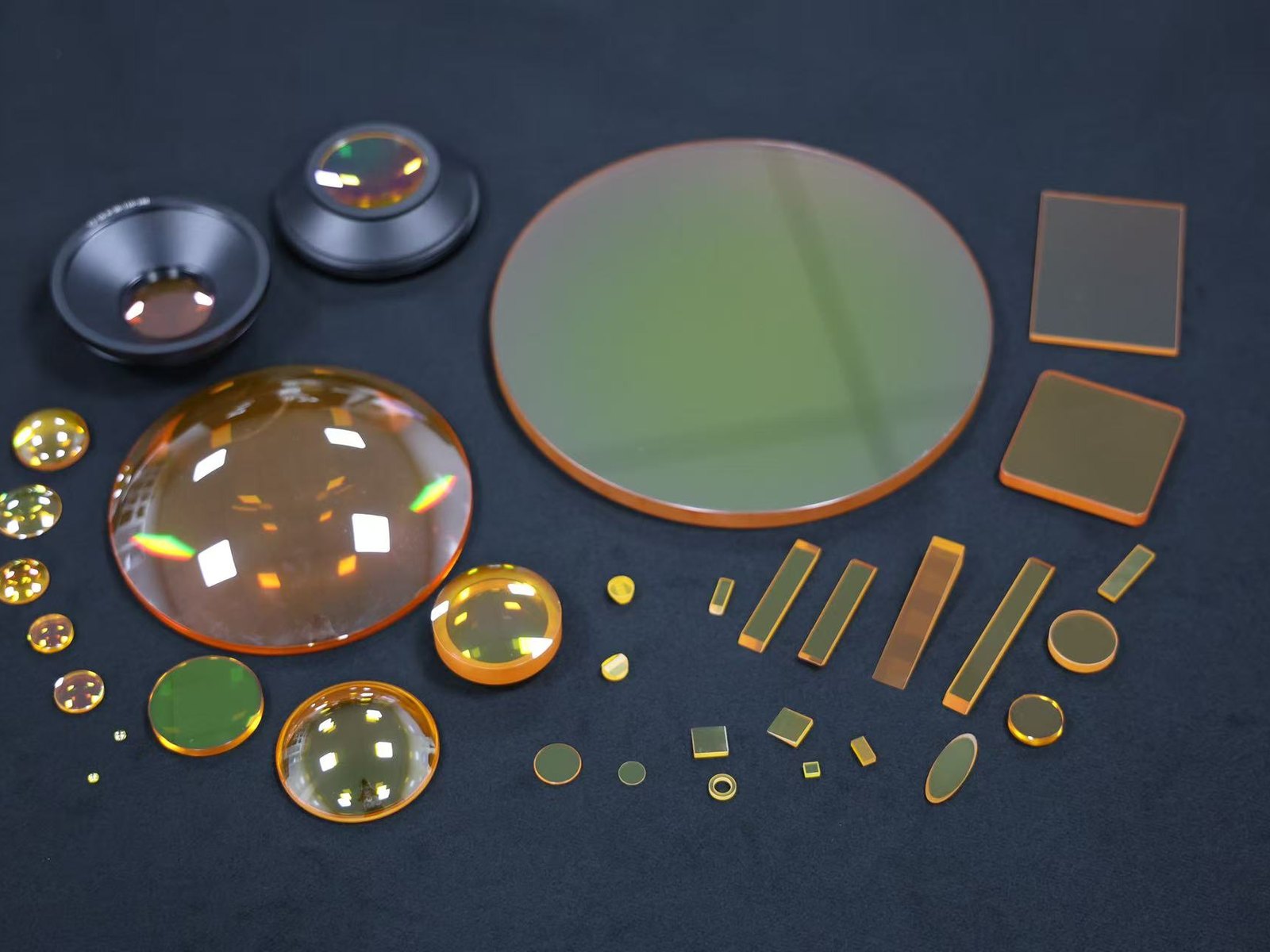
Used in
Industrial and medical CO₂ lasers, thermal imaging cameras, process-monitoring windows and full-scene infrared optics from 0.6 to 21 µm.
- Flagship process — two decades dedicated to ZnSe
- Diffractive elements: PV 0.134 µm, RMS 0.01 µm
- Largest clear apertures in the catalog, up to 400 mm
Capability
| Diameter | φ2 – 400 mm | |
|---|---|---|
| Scratch / Dig | 20 / 10 | 1300 Lux |
| PV | λ/8 @ 632.8 nm | Zygo |
| Irregularity | 0.1 λ @ 632.8 nm | Zygo |
| RMS | λ/50 @ 632.8 nm | Zygo |
| Parallelism / decentration | 3″ / 30″ |
Forms & coatings
Forms
- Windows (round / rectangular)
- Plano-convex, biconvex, meniscus lenses
- Prisms & wedges
- Aspheres & special shapes
- Diffractive optical elements
Coatings
- BBAR 8–12 µm
- BBAR 2–14 µm
- AR @ 2.94 µm
Curves are measured on 1–2 mm plane-parallel witness coupons.
ZnSe for 10.6 µm CO₂ lasers
CVD zinc selenide is the house specialty for high-energy CO₂ work at 10.6 µm (also specified at 9.3 µm). The published transmission band is 0.6–21 µm. Low-absorption CVD ZnSe is the standard substrate for focusing lenses, output windows and scan optics in cutting, welding, marking and medical CO₂ systems.
OEMs and integrators specifying a 10.6 µm (or 9.3 µm) path typically start from this material page for windows and focusing lenses, then route scan-head RFQs to Laser assemblies. Keep absorption language qualitative on the drawing; keep coating wavelength explicit so the factory applies the correct AR line. Compare other IR substrates on the Materials hub when the band is not CO₂.
Typical use cases
- Industrial and medical CO₂ lasers — focusing lenses and output windows
- F-theta / scan assemblies for marking and cutting (see Laser assemblies)
- Thermal imaging and process-monitoring windows — same substrate; different coating line than CO₂ AR
Absorption language for the RFQ
Use catalog phrasing: “low bulk absorption at 10.6 µm” / “low-absorption CVD ZnSe”. Do not invent %/cm, ppm, or absorption coefficients on the drawing. If a numeric absorption callout is required, confirm with the factory.
AR / coating line on the drawing
Catalog coatings on this page: BBAR 8–12 µm (thermal cameras), BBAR 2–14 µm (broadband instruments), and AR @ 2.94 µm (Er:YAG / medical). Assemblies use ZnSe optics AR-coated for 9.3 / 10.6 µm CO₂. For a dedicated CO₂ focusing lens or window RFQ, name wavelength 9.3 or 10.6 µm and ask the factory for the matching AR line — numeric R% or coating stack name if not on the drawing: confirm with factory. Curves are measured on 1–2 mm plane-parallel witness coupons.
Drawing callouts that speed the quote
Map the capability table into RFQ bullets so the Changzhou export desk can quote without back-and-forth. Catalog typicals (not a guarantee for every lot):
- Material — CVD zinc selenide (CVD ZnSe)
- Wavelength / band — 0.6–21 µm; name 9.3 or 10.6 µm for CO₂ RFQs
- Diameter — φ2 – 400 mm; include clear aperture and wedge for large parts
- Scratch / Dig — 20 / 10 (1300 Lux)
- Figure — PV λ/8, irregularity 0.1 λ, RMS λ/50 @ 632.8 nm (Zygo when required)
- Parallelism / decentration — 3″ / 30″ when needed
- Form — window (round/rectangular), PCx / biconvex / meniscus, prism/wedge, asphere, or DOE
- Coating — BBAR 8–12 µm, BBAR 2–14 µm, AR @ 2.94 µm, or CO₂ AR at 9.3/10.6 µm (exact CO₂ callout: confirm with factory)
- DOE (if applicable) — published figures PV 0.134 µm, RMS 0.01 µm
- Metrology docs — English drawings, coating curves, and Zygo with the export lot
Quote CVD ZnSe for 10.6 µm (or 9.3 µm): send diameter, clear aperture, form, S/D / figure callouts, and coating wavelength to [email protected] or the inquiry form.
Questions buyers ask
- Why is ZnSe used for CO₂ laser lenses?
- CVD zinc selenide has very low bulk absorption at 10.6 µm, high thermal shock resistance and a wide 0.6–21 µm window, so it is the standard substrate for CO₂ focusing lenses, output windows and F-theta scan lenses.
- What coating should I specify on a ZnSe window?
- For thermal cameras, BBAR 8–12 µm. For broadband instruments, BBAR 2–14 µm. For Er:YAG medical lasers, AR at 2.94 µm. We measure every run on plane-parallel witness coupons.
- What is the largest ZnSe optic THOI can polish?
- Catalog diameter is φ2–400 mm. Large-aperture windows use 1.2–2.0 m ring-polish tables; send the clear-aperture and wedge requirement with the RFQ.
- Do you supply ZnSe optics for 10.6 µm CO₂ lasers?
- Yes. Low-absorption CVD ZnSe is specified for 9.3 and 10.6 µm cutting, welding, marking and medical lasers. On this page: windows, focusing lenses, aspheres and DOEs (φ2–400 mm). Matching F-theta / 3-axis / expander assemblies are listed under Laser assemblies. Send wavelength, diameter, form and coating requirement with the RFQ.
- What should I put on a ZnSe drawing for a CO₂ focusing lens or window?
- Material (CVD ZnSe), wavelength (9.3 or 10.6 µm), diameter and clear aperture, form (window / plano-convex / meniscus / etc.), surface quality (catalog typical S/D 20/10), figure (PV λ/8, RMS λ/50 @ 632.8 nm on Zygo when required), parallelism/decentration if needed (catalog 3″ / 30″), and coating line. For thermal windows use BBAR 8–12 µm or BBAR 2–14 µm; for CO₂ AR naming beyond 9.3/10.6 µm, confirm the exact coating callout with the factory. Witness-coupon coating curves and Zygo reports ship with export lots.
Transmission windows
One factory, 0.4 to 21 µm
Pick a material by infrared band. Typical design windows overlay a log-scale spectrum from NIR through LWIR.
- ZnSe0.6 – 21 µm
- ZnS0.4 – 12 µm
- Si1.2 – 7 µm
- ChG1 – 14 µm
Other substrates